Focal length
Focal length, in millimetres, tells you how much the lens sees. Small numbers take in a lot of the scene, large numbers bring things closer. With portraits, though, there’s a surprise: it isn’t the focal length that changes the face, it’s the distance.
1Simulator
What each focal length sees
Stay in the same spot and change the focal length: see how much the frame tightens. Then switch from full frame to APS-C: the same lens frames like one 1.5 times longer.
2Simulator
Same framing, different focal length
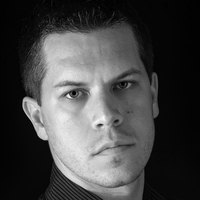
Now my face always stays the same size: with the wide-angle you have to move closer, with the telephoto further away. Look at the nose, the ears and the background.
Full frame and APS-C
1Simulator The focal lengths in this lesson are full frame ones, the sensor the size of a frame of film. On an APS-C camera the sensor is smaller and crops the centre of the image: every lens frames as if it were 1.5 times longer (1.6 on Canon). A 35 mm on APS-C frames like a 50 mm on full frame, a 50 mm like a 75 mm. The Ricoh GR IV, with its 18.3 mm lens on APS-C, frames like a 28 mm.
The distance trick
2Simulator With a 14 mm, to fill the frame with a face you have to be a few centimetres away: the nose is much closer to the lens than the ears and becomes huge. With a 135 mm you stand a few metres away and the face looks natural.
2Simulator The same goes for the background: the further you move from the subject, the bigger and closer the background looks. This is telephoto compression. For portraits, focal lengths between 50 and 135 mm are the usual choice.
Key points
- Short focal length (14–35 mm) = wide angle: lots of scene, good for landscapes and interiors.
- Long focal length (85–200 mm) = narrow angle: brings distant subjects closer and compresses the background.
- Facial distortion depends on distance: for tight portraits stand back and use a focal length between 50 and 135 mm.
- On APS-C multiply the focal length by 1.5 (1.6 on Canon) to know how it frames compared with full frame: a 35 mm becomes roughly a 50 mm.
Try it yourself
Take a portrait of a friend twice, with the face the same size: once very close with the wide-angle (or the 0.5× ultra-wide of an iPhone or Android smartphone) and once from a few metres away with the longest focal length you have. Compare the nose and the background.
Post the result and tag me @enrico.marega, or send it to me by DM: I’d love to see how you tackled it.
Quick check
Was this useful?
Follow me on Instagram: under every photo I post you’ll find the shooting settings, so you can see these lessons at work on the street. On YouTube you’ll find short videos.
Got a question about this lesson? Send me a DM on Instagram.